A new peer-reviewed publication from the Synthesa team evaluates the latest evidence on colchicine for preventing major adverse cardiovascular events (MACE).
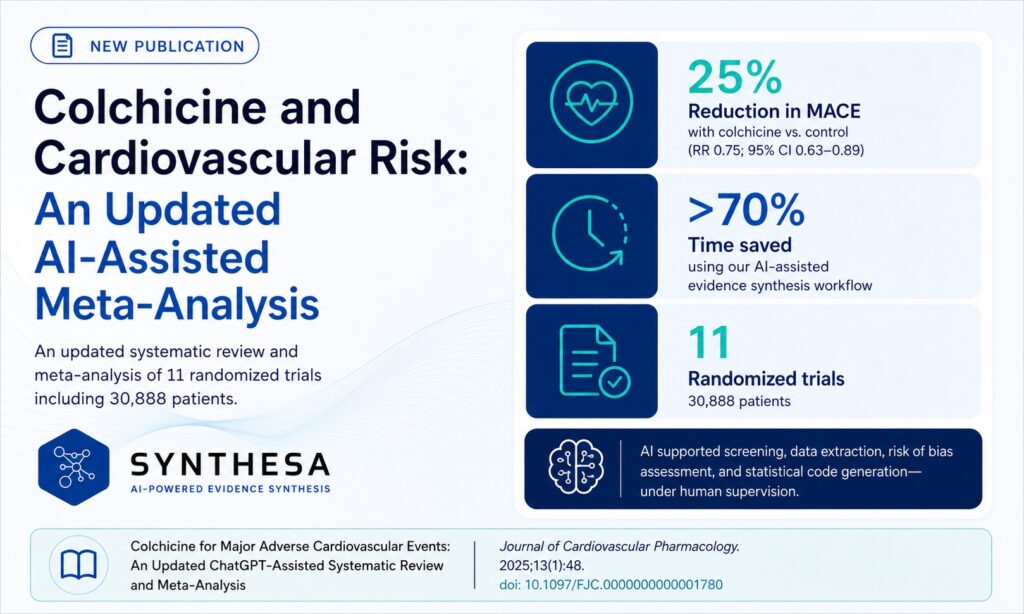
The updated systematic review and meta-analysis included 11 randomized trials involving 30,888 patients. Colchicine was associated with a 25% reduction in the risk of major adverse cardiovascular events, although the addition of the CLEAR trial reduced the certainty and consistency of the overall evidence. No statistically significant effects were found for myocardial infarction, stroke, cardiovascular mortality, or all-cause mortality individually.
The study also demonstrates how LLMs can support evidence synthesis. Under human supervision, AI assisted with screening, data extraction, risk-of-bias assessment, and statistical code generation, reducing researcher time by more than 70%.
The findings highlight two important points: evidence must be updated as new trials become available, and purpose-built AI workflows can make systematic reviews substantially faster without removing expert oversight.
Read the publication
Lefteris Teperikidis, Aristi Boulmpou, Manisha Chownk, Rohan Jagdale, George W. Booz, Giuseppe Biondi-Zoccai, and Deepak L. Bhatt.
Colchicine for Major Adverse Cardiovascular Events: An Updated ChatGPT-Assisted Systematic Review and Meta-Analysis
Journal of Cardiovascular Pharmacology
DOI: 10.1097/FJC.0000000000001780