A new peer-reviewed validation study provides compelling evidence that Synthesa AI can make systematic review screening faster, more comprehensive, and more reproducible than conventional human-led workflows.
Published in the Journal of Cardiovascular Pharmacology, the study evaluated Synthesa AI across 17 benchmark meta-analyses covering nine therapeutic domains relevant to pharmacology and clinical practice.
The results were unequivocal:
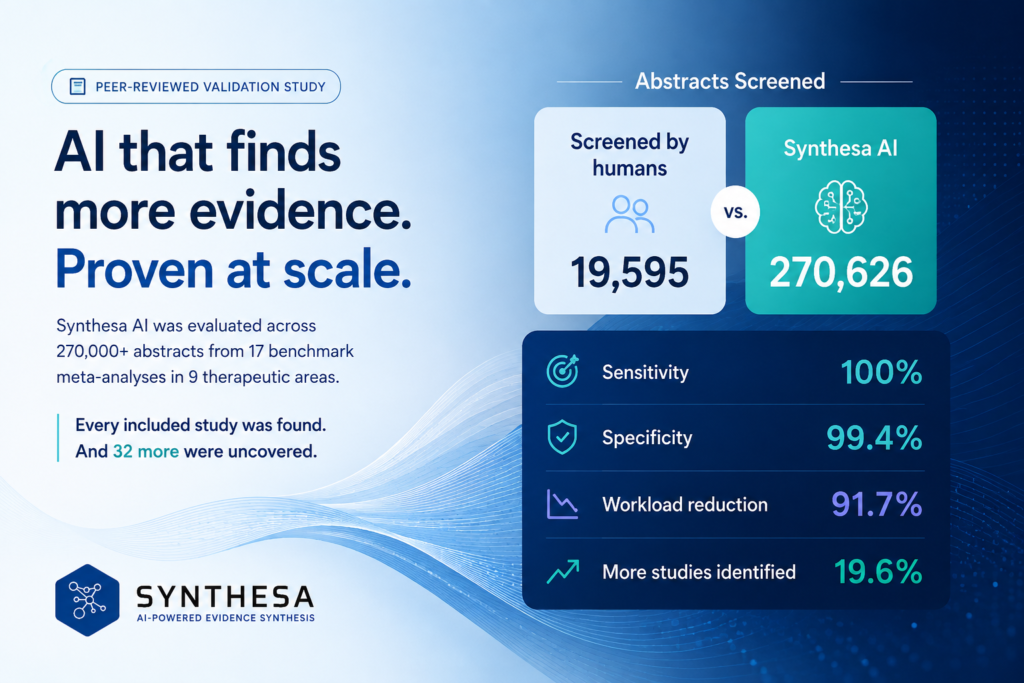
- 270,626 abstracts screened
- 100% sensitivity
- 99.4% specificity
- 91.7% reduction in reviewer workload
- 32 additional relevant studies identified that the original reviews had missed
This is not simply a demonstration that AI can accelerate abstract screening. It shows that, under the conditions evaluated, Synthesa AI matched or exceeded the evidence-retrieval performance of the original human-led review teams.
Testing Synthesa AI against completed systematic reviews
To evaluate the reliability of Synthesa AI, the researchers used 17 previously completed meta-analyses as benchmarks.
Searches were recreated across PubMed and Scopus, producing a combined dataset of more than 270,000 abstracts. Synthesa AI then screened the records using the eligibility criteria of each review.
The included studies from the original meta-analyses served as the benchmark against which the AI’s decisions were assessed.
This created a demanding validation environment. Synthesa AI had to process a very large and heterogeneous evidence base while maintaining the sensitivity required for rigorous systematic reviews.
Every benchmark study was identified
Missing an eligible study is one of the most consequential risks in systematic review screening. Relevant evidence that is incorrectly excluded may affect effect estimates, conclusions, and subsequent clinical or strategic decisions.
Across the 17 benchmark reviews, Synthesa AI successfully identified all 163 studies included in the original meta-analyses.
This produced a sensitivity of:
100%
The corresponding 95% confidence interval was 97.7% to 100%.
At the same time, Synthesa AI achieved 99.4% specificity, demonstrating that high sensitivity did not require sending an unmanageable number of irrelevant records forward for human assessment.
91.7% less screening work
Traditional abstract screening can require two independent reviewers to assess thousands, or sometimes tens of thousands, of records.
Synthesa AI substantially reduced this burden.
Following AI screening, only 1,797 abstracts required manual review, corresponding to a 91.7% reduction in reviewer workload under the study’s methodology.
This has important practical implications for healthcare, pharmaceutical, medical device, CRO, and medical communications teams.
Reducing the volume of manual screening can:
- Shorten systematic review timelines
- Reduce reviewer fatigue and inconsistency
- Allow scientific teams to focus on complex eligibility decisions
- Make large and frequently updated evidence bases more manageable
- Support more efficient living systematic reviews
The objective is not to remove expert oversight. It is to direct that expertise toward the records and decisions where it creates the greatest value.
Synthesa AI found studies the original reviews missed
Perhaps the most important result was not that Synthesa AI replicated the original reviews.
It was that the AI improved on them.
Synthesa AI identified 32 additional relevant studies that had not been included in the benchmark meta-analyses. This represented a 19.6% increase in evidence yield relative to the 163 benchmark-included studies.
In other words, the original human-led reviews had missed relevant evidence that Synthesa AI was able to recover.
This finding directly challenges the assumption that AI-assisted screening necessarily trades scientific rigour for speed. In this validation, greater efficiency was accompanied by greater comprehensiveness.
For evidence synthesis teams, this matters enormously. The value of faster screening is limited if relevant evidence is overlooked. Synthesa AI demonstrated that it can reduce workload while preserving, and potentially improving, the completeness of the resulting evidence base.
Transparent and criteria-driven AI screening
Synthesa AI uses a prompt-driven framework based on the review’s predefined inclusion and exclusion criteria.
This is fundamentally different from treating a general-purpose chatbot as an autonomous reviewer.
The workflow is designed specifically for evidence synthesis and produces transparent screening outputs that can be reviewed by scientific experts. Human oversight remains part of the process, but repetitive record assessment is substantially reduced.
This combination of AI-driven scale and expert supervision offers a practical model for conducting high-quality systematic reviews more efficiently.
What this validation means for evidence synthesis
AI tools used in systematic reviews should be evaluated using the same principles applied to other scientific methods: transparent methodology, reproducible testing, clearly defined benchmarks, and measurable performance.
This study provides that evidence for Synthesa AI.
Across more than 270,000 abstracts and 17 benchmark meta-analyses, Synthesa AI:
- Recovered every study included in the original reviews
- Reduced the manual screening workload by more than 90%
- Maintained very high specificity
- Identified additional eligible evidence missed by the original review teams
The findings demonstrate that purpose-built AI can do more than make systematic reviews faster. It can help make them more comprehensive, reproducible, and scalable.
For organisations making clinical, regulatory, market access, or product-development decisions, this means faster access to a stronger evidence base, without accepting lower methodological standards.
Read the publication
Validation of Synthesa AI, a Large Language Model-Based Screening Tool for Systematic Reviews: Results From 9 Pharmacologic Studies
Lefteris Teperikidis, Christos Trampoukis, and Kyiakos Polymenakos
Journal of Cardiovascular Pharmacology. 2026;87(6):387–393.